
On The Calculation Of Volume
The appeal of living in the eternal present

During a work trip to Paris, Tara Selter spots the same hotel guest drop the same piece of bread during breakfast, the bread falling in the same way - a “gently swerving descent”. The guest has the same reaction, apparently anxious to be seen wasting good food, before eventually disposing of the bread. This is the second clue Tara finds that the eighteenth of November is repeating itself, the first being the newspaper showing what she thinks should be yesterday’s date. On The Calculation Of Volume is one of those “infinite time loop” stories, like Palm Springs or Groundhog Day, in which the main character cannot stop living the same dreary November day, over and over again.
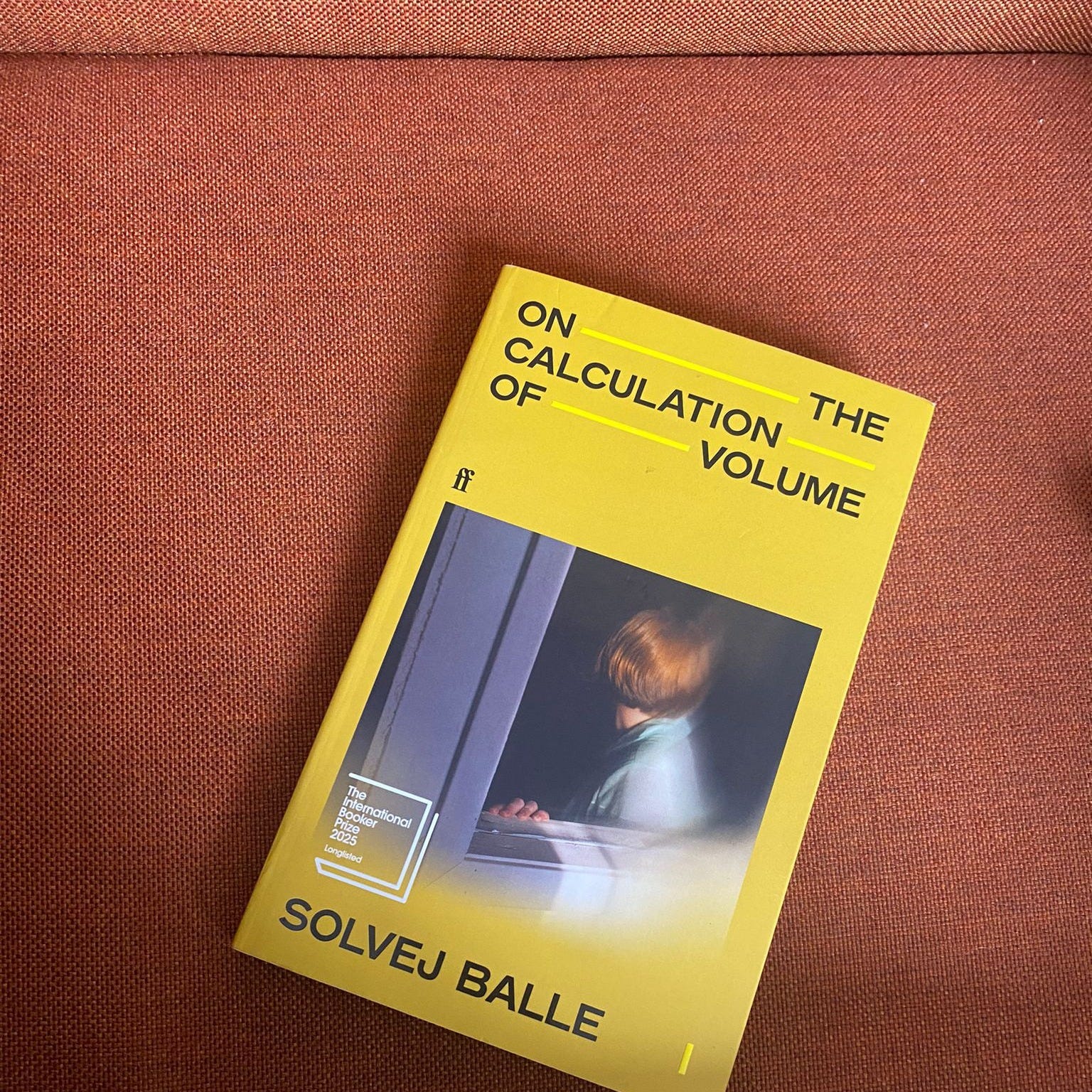
I read this book in two days, which might be unremarkable were in not for the fact I am currently a fulltime carer for my four year old son, and occasionally find it too exhausting to eat - to put my hand to my mouth and chew and swallow, even if the food in placed directly in front of me - let alone to read a book. But I found myself peculiarly besotted with On The Calculation Of Volume, reading it compulsively, while the kettle boiled, while my son watched Octonauts; staying up late to read it in bed. Coming away from the book felt like waking up in the middle of the night having left a blissful dream, wanting to fall urgently back inside. Which is strange considering the book is about a woman’s despair as she fails to find her way out of the eighteenth of November, her desperation and grief as she sees the distance between herself and her love, and everyone else, grow unbreachable, as their timelines grow further and further apart. But I found the book, and the concept…extremely cosy? Profoundly reassuring? Actual heaven?!
I guess this is partially because of its dreamy sense of the uncanny, which I have always found both pleasurable and disturbing, in the way the dream logic of the novel plays out. It feels like a dissociative fantasy, somewhere between reality and irreality. It is also an objectively cosy book. It takes place at the pinnacle of autumn, and there is a lot of hot coffee, the patter of rain against the windows. There is a sequence in which she fries an egg that makes frying an egg seem like the most delectably nourishing act anyone has ever ventured upon. And though the novel takes place in rural France, it feels a very Nordic version of France (the author is Danish). It feels extremely fucking Danish! Though I suppose the main thing I find cosy and reassuring about the novel is the appeal of living in the eternal present.
My son is currently midway through a course of chemotherapy, having been diagnosed with a rare form of cancer three months earlier. My present is hard: seeing the effects chemotherapy has on his tiny body, watching him suffer various punishing procedures, the laborious day-to-day of taking care of him. I haven’t been to the office since April, cannot travel further than around an hour from the hospital, and am living in I guess an unusual domestic situation. He was due to start school this week, but will be deferring until January. I am looking forward to his treatment coming to its end, to some return to normality, but also, I am absolutely terrified of it, because I am terrified of the future. The present may be hard but it is (to a degree) certain: my boy is right there where I can touch him, often sleeping literally on top of me throughout the night. He is in treatment. He is getting better. We are up a mostly upward trajectory, but what happens beyond this is unknown. If I could press a button to remain suspended on a good or average day now, I would be tempted to press it.
There is also a lot of uncertainty in my current day-to-day. If my son has a temperature I have to take him straight into hospital for what is generally a 48 hour stay. He has mostly bounced back quickly from his chemotherapy infusions, but then unexpectedly, his most recent infusion knocked him off his feet, meaning he was too poorly to go for a walk in the park, to do very much beyond watch TV. Living in the eternal present, a day I already know the shape and rhythms of, is an extremely comforting prospect.
There are also frustrations in On The Calculation of Volume which I find soothingly recognisable. Tara relives the same day with the same quotidian events, over and over. It reminds me of Gertrude Stein and her repetition of words and phrases, the repeat exposure destabilising their meaning, growing new meanings, becoming absurd, eventually emptying entirely of meaning, just a strange sound. The more I go through the motions of care work, which is repetitive, laborious work, the less real it feels, and the more time seems elastic. I can’t get a handle on it or position myself within it.
Tara panics at the distance that emerges between her and her love as the days grow in number between them, she talks frequently of his time and her time. My time feels removed from everyone else’s, an entirely separate entity shared between me and my son and his dad. My friends are having babies, going out, getting married, falling in love. I am setting up nasogastric feeds, administering medication, waiting for hours in A&E. Time in hospital moves at the speed of light, filled with lengthy procedures, nerve-wracking meetings with oncologists, else it moves at an excruciatingly slow pace - how many ways can you entertain a four year old who is confined to a hospital bed and attached to a drip, for days at a time?
Something else that emerges in the novel is the theme of attention: of how we pay attention and what we pay attention to. Tara notices incremental shifts in temperature on a breeze, can predict patterns of birdsong, the sound of a car two streets away. As the day empties itself of new details, she starts noticing things at night: “You would think the dark wouldn’t have details, but that is only if you don’t count the sounds. Or the light glimpsed up there. A little snippet of sky.”
I think there is something quietly radical in exercising discipline around the things we choose give our attention to. I used to apply this thought to i.e. not giving a shit when Donald Trump says something sexist, but recently it has felt more personal. In the last couple weeks I have noticed myself growing depressed, not in the residues of shock, or in grief - just familiar old depression. Struggling to take pleasure in things that used to give me joy. Not wanting to get out of bed in the morning. Feeling just exquisitely sorry for myself. Probably I need to switch antidepressants, but in the meantime, noticing a particular aspect of light or the sound of the trees or the smell of the rain can keep me going a little longer. Last week, I had some focaccia that felt god sent; I couldn’t shut up about it. It turned my whole day around.
On The Calculation of Volume is, ridiculously, part of a seven-volume series - all set on the eighteenth of November. I have the second book, with a proof of the third in transit, but I want to meter them out a little. The series, originally written in Danish, is in the process of translation, and so the remaining books won’t be around to keep me company for a little while longer.
A few years earlier when I was having an extremely hard time with insomnia, I found myself listening to the Okkervil River song Our Life Is Not A Movie Or Maybe for a little pep through those awful sleepless nights, and now I cannot bring myself to listen to the song at all, so entrenched is it within this difficult period of time for me. And so I suspect, when the final volumes of On The Calculation of Volume are released in English, I’ll be definitively done with it being the eighteenth of November.
A moving and beautiful piece. My best wishes and thoughts are with you and your son ❤️
What a beautiful meditation on life and time. Sending love and strength to you and your family xx